
How Midsumma is redefining cultural participation as economic and social infrastructure in Australia
By Felicity McIntosh, Deputy CEO - Midsumma
For decades, arts and cultural participation have been positioned as secondary to economic development, valuable for celebration, tourism and identity, but rarely recognised as essential infrastructure within broader social and economic systems.
However, emerging research increasingly demonstrates that inclusive cultural participation contributes directly to workforce engagement, economic activation, social cohesion and community resilience.
At Midsumma Festival, we see this relationship in practice every year.
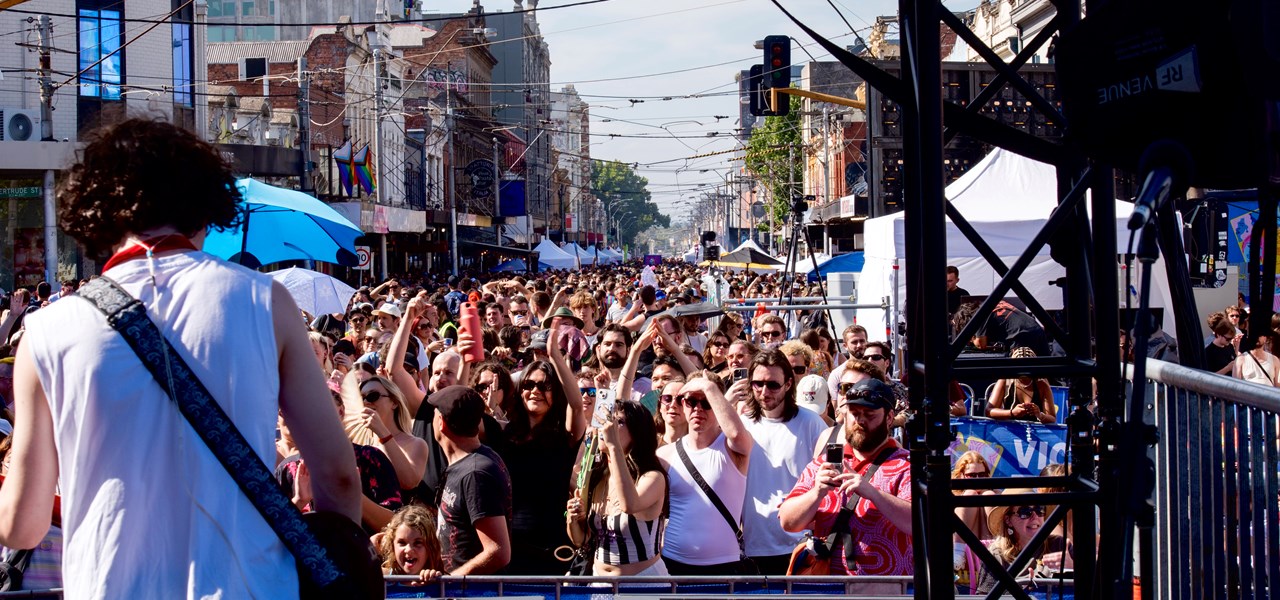
As Australia’s premier LGBTQIA+ arts and cultural organisation, Midsumma now engages more than 330,000 attendees annually across metropolitan and regional Victoria through performances, exhibitions, public events, artist development initiatives and community-led programming.
What is becoming increasingly clear, through both longitudinal evaluation and lived experience, is that the outcomes generated through queer cultural participation are not solely cultural or social. They are economic.
This is the foundation of what we describe as the Midsumma Equity Infrastructure Model: the understanding that inclusive cultural participation functions as infrastructure that strengthens workplaces, markets and communities simultaneously.
Cultural participation as economic infrastructure
Midsumma is often publicly understood as a three-week summer festival. In reality, it operates as a year-round cultural ecosystem spanning:
- artist and workforce development
- accessibility and inclusion initiatives
- regional and metropolitan programming
- public activations
- strategic partnerships
- community capacity building
- creative employment pathways
This distinction matters because sustained cultural infrastructure produces sustained economic and social outcomes.
In 2026, Midsumma generated approximately $87 million in economic activity across Greater Melbourne. This included direct audience expenditure across hospitality, accommodation, tourism, retail and transport, alongside broader creative industry activation and workforce participation outcomes.
Midsumma Festival, across three weeks, generated approximately $30 million in direct economic impact, reinforcing the role large-scale LGBTQIA+ cultural events play within local tourism and business ecosystems.
Importantly, these outcomes are not disconnected from inclusion; they are driven by it.
Participation increases when people feel safe, visible and welcomed within public space.
Midsumma’s 2026 evaluation data found:
- 97% of attendees felt safe and welcome
- 91% reported increased community connection
- 97% identified the festival as important to their local area
These findings demonstrate that belonging itself contributes to economic participation. Audiences engage more deeply when cultural environments are designed inclusively and authentically.
Inclusion expands workforce participation
The economic value of cultural infrastructure also extends into employment pathways and professional participation.
Through initiatives such as Midsumma Pathways and Futures, Midsumma supports emerging LGBTQIA+, Deaf, disabled and neurodiverse creatives through mentorship, presentation opportunities and industry development.
Between 2020 and 2025:
- 38 Pathways participants generated 66 paid employment opportunities
- participants secured 73 festival engagements
- program outcomes increased by more than 1,700% since 2022
Across the same period, 47 mentors delivered 376 one-to-one mentoring sessions, contributing to both participant development and broader sector capability-building in accessibility and inclusive practice.
These outcomes demonstrate that accessibility is not an “add-on” to cultural participation. It is a mechanism for expanding workforce access, creative contribution and economic inclusion.
This aligns with broader national and international research showing that inclusive environments improve participation, well-being, and productivity outcomes across both creative and non-creative industries.
Why this matters in the current economic climate
Australia is currently navigating rising cost-of-living pressures, workforce instability and increasing social fragmentation. During periods of economic volatility, arts and cultural participation are often framed as discretionary.
Yet evidence increasingly suggests the opposite.
Research from organisations including the OECD and UNESCO identifies cultural participation as a contributor to social resilience, mental well-being, and local economic sustainability.
Midsumma’s own evaluation data reinforces this relationship.
Through a distributed delivery model spanning metropolitan and regional Victoria, alongside significant free and low-cost programming, Midsumma reduces barriers to participation while supporting artists, local businesses, venues and communities.
At the same time, the social outcomes generated through inclusive cultural participation become increasingly important during periods of financial and social pressure.
As isolation and economic stress increase, opportunities for visibility, connection and collective participation become critical forms of civic infrastructure.
Partnership as equity infrastructure
Midsumma’s impact is strengthened through long-term partnerships spanning government, corporate and community sectors.
Collaborations with organisations including National Australia Bank, RMIT University, Transport Accident Commission and Creative Australia demonstrate how cultural partnerships can extend inclusion beyond festival environments and into workplaces, public policy and institutional systems.
Importantly, the most effective partnerships are not transactional. They are collaborative, community-informed and values-led.
They recognise that supporting LGBTQIA+ cultural infrastructure is not simply about visibility. It is about contributing to environments where people can participate more fully in social, economic and professional life.
A framework for the future
The future of cultural policy, investment and partnership cannot be measured through attendance alone.
It requires broader frameworks that recognise inclusion, accessibility, wellbeing, and participation as measurable contributors to economic and social resilience.
The Midsumma Equity Infrastructure Model proposes exactly this: a model where visibility, participation and belonging function as economic infrastructure rather than secondary outcomes of growth.
This includes:
- embedding accessibility into organisational design
- supporting long-term creative workforce pathways
- strengthening regional and metropolitan participation
- recognising belonging as a contributor to economic engagement
- understanding cultural participation as part of broader civic infrastructure
At Midsumma, we believe culture does more than reflect society.
It helps create the conditions for people to participate fully within it.
And when participation expands, socially, creatively and economically, communities, workplaces and industries become stronger for everyone.
Download our general Midsumma Partnership Prospectus to get an idea of where to start
- yes, it has investment numbers (we like to be transparent).
Up for a chat? Speak with our Midsumma Team:
 Deputy CEO - Felicity McIntosh
 Partnerships Manager - Josh Hernandez
Let’s build meaningful participation in culture, together.
References
Banks, M. (2017). Creative Justice: Cultural Industries, Work and Inequality. Rowman & Littlefield.
Baumol, W., & Bowen, W. (1966). Performing Arts: The Economic Dilemma. Twentieth Century Fund.
Castiglia, C., & Reed, C. (2020). If Memory Serves: Gay Men, AIDS, and the Promise of the Queer Past. University of Minnesota Press.
Deloitte. (2021). LGBT+ Inclusion @ Work: A Global Outlook. Deloitte Insights.
Department of Social Services. (2022). National Disability Employment Strategy 2022–2032. Australian Government.
Florida, R. (2002). The Rise of the Creative Class. Basic Books.
Gibson, C., & Davison, A. (2019). Arts, Culture and Sustainability: Building Capabilities in the Creative Economy. Springer.
Kafer, A. (2013). Feminist, Queer, Crip. Indiana University Press.
Markusen, A. (2006). Cultural planning and the creative city. International Journal of Urban and Regional Research, 30(4), 289–302.
Midsumma Festival. (2024). Midsumma Economic Impact Report 2024. Melbourne, Australia.
Midsumma Festival. (2024). Midsumma Pathways Evaluation 2020–2024. Melbourne, Australia.
Midsumma Festival. (2025). Midsumma Festival 2025 Evaluation Report. Melbourne, Australia.
Midsumma Festival. (2026). Midsumma Economic Impact Report 2026. Melbourne, Australia.
Oakley, K., & O’Connor, J. (2020). The Cultural Industries in the Digital Age. Routledge.
OECD. (2020). Culture and Local Development: Maximising the Impact. OECD Publishing.
Pratt, A. C. (2019). The cultural economy and the global creative turn. Social and Cultural Geography, 20(1), 1–17.
Pride in Diversity. (2022). Australian Workplace Equality Index (AWEI) National Report. Sydney.
Sender, K. (2018). The Gay Market Goes Mainstream. Routledge.
UNESCO. (2022). Re|Shaping Policies for Creativity – Addressing Culture as a Global Public Good. UNESCO Publishing.
Victoria’s Pride – Midsumma. (2025). Victoria’s Pride Economic Impact Report 2025 v2.0. Melbourne, Australia.
Yoshino, K. (2006). Covering: The Hidden Assault on Our Civil Rights. Random House.